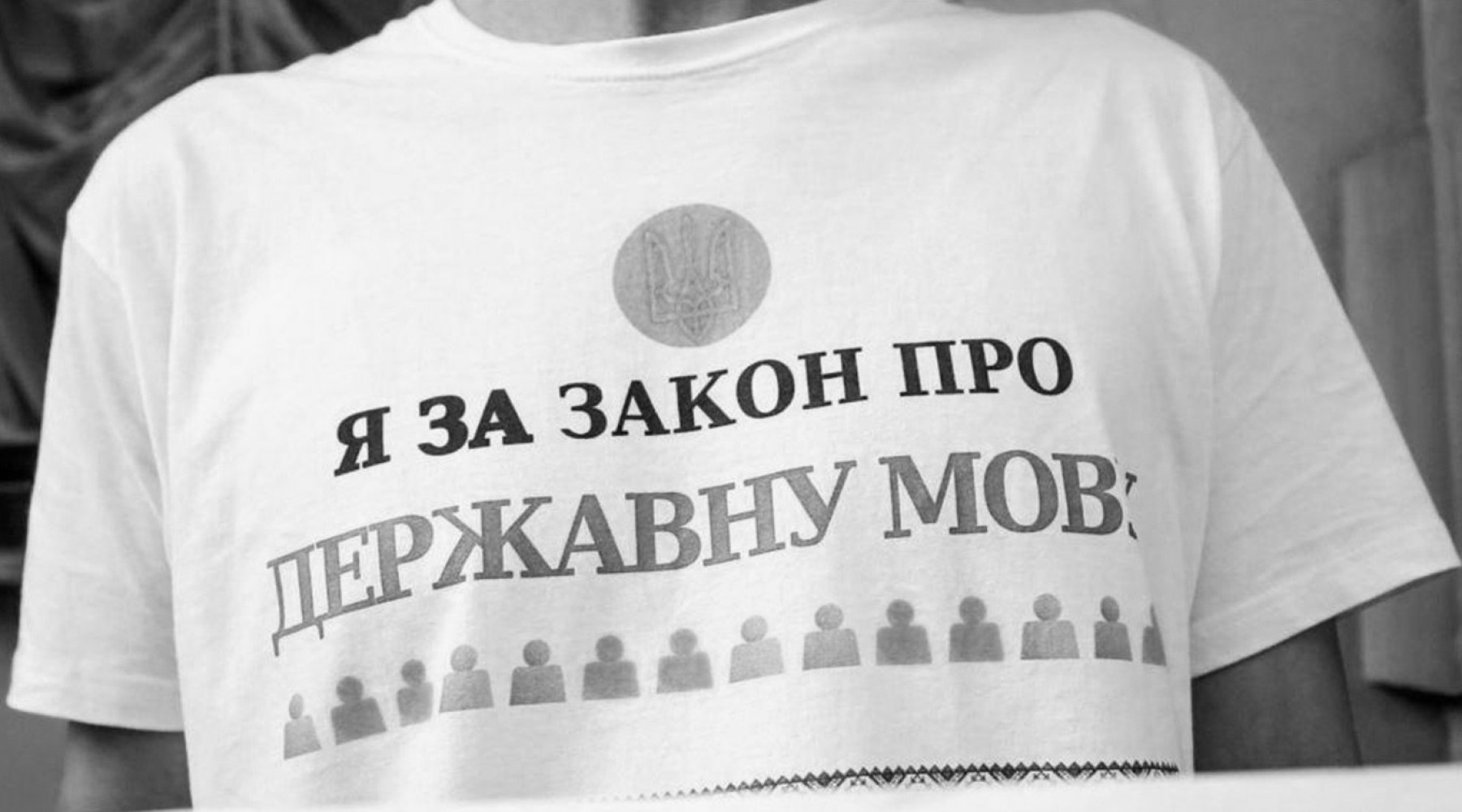
The Verkhovna Rada of Ukraine approved the Law of Ukraine “On ensuring the functioning of the Ukrainian language as a state language”.
According to the law, Ukrainian language should be spoken in public space, in the state and municipal sectors, in transport, in catering establishments. Also, the state language should be the signatures and markings on the goods, as well as the description of services.
Ukrainian language must be used in the medical sphere, in the field of education, during theatrical performances, and also the films dubbing. The language of television, the Internet and print media is Ukrainian. The law also provides that more than 50% of titles of print media should be in the state language, and the Ukrainian version of the site should be downloaded automatically. In addition, it should be in terms of volume not less than foreign language.
Such requirements do not apply to private life and religious ceremonies.
It is provided not only the responsibility to the special commissioner for non-compliance with the law, but also the general administrative authority. However, the system of penalties and fines will take effect only in three years.
Fines for violating the language law:
- in clerical work and law enforcement officers – from UAH 3 400 to 6 800;
- in the field of culture, education, advertising – from UAH 3 400 to 6 800;
- in print media – from UAH 6 800 to 8 500;
- in the areas of public communication – from UAH 3 400 to 5 100;
- on television or radio – from UAH 8 500 to 10 200;
- in the provision of information in the service sector – from UAH 5 100 to 6 800;
- for failure to comply with the legal requirements of the language inspector – from UAH 1 700 to 3 400;
- for public humiliation or lack of respect of the official language – UAH 850
In other cases, a fine of UAH 3 400 to 5 100 is provided. However, if the violation occurred for the first time, it could be only the warning. If someone breaks the law for a second time in a year, then the fine will amount to UAH 8 500 – 11 900.
The State Fiscal Service of Ukraine in its Individual Tax Advice “On the Lawfulness of including in the tax credit to the amounts of VAT accrued (paid) by the taxpayer in connection with the purchase of goods/services for sanitary and administrative and administrative expenses (drinking water, tea, coffee , sugar, biscuits, canned food, flowers, etc.)” of 18.04.2019, No. 1673/6/99-99-15-03-02-15/ІПК reported that the amount of value added tax (hereinafter – VAT), accrued (paid) by the VAT payer in connection with the purchase of goods/services, including for sanitary and hygienic, and economic and administrative expenses (drinking water, tea, coffee, sugar, biscuits, canned food, flowers, etc.) should be included in the tax credit, subject to the availability of appropriate documentary evidence (tax invoices/adjustments calculations registered in the URTI, customs declarations, other documents stipulated by para. 201.11 of TCU).
If the cost of these goods is included in the costs and, accordingly, in the value of the goods/services whose supply transactions are subject to taxation (that is, they are compensated by the purchasers, while increasing the VAT base), these goods are recognized as being intended for use/used in business activities, in taxable transactions, and additional charge of tax liabilities according to the rules established by para. 198.5 of TCU, is not carried out.
The State Fiscal Service of Ukraine in its Individual Tax Advice “On the Basis for Collecting a Tourist Duty” of 17.04. 2019, No. 1654/6/99-99-12-02-03-15/ІПК considered the following situation. The hotel’s clients go to the hotel early and leave late. The question arises: how to collect a tourist tax in this case?
According to the Rules for the use of hotels and similar facilities for accommodation and provision of hotel services, approved by the order of the State Tourism Administration of Ukraine dated March 16, 2004, No. 19, the fee for the provision of hotel services is made on a single settlement hour – at 12:00 p.m. of the current day local time.
Thus, the countdown of the period of residence begins at 12:00 p. m. on the day of arrival (arrival) and lasts 24 hours before the settlement time set by the hotel.
If clients arrive by 12:00 p.m. on the day of arrival and depart after 12:00 p. m. on the day of departure, for the purpose of taxation, two days should be added to the number of residence days: one for exceeding the settlement hour during the check-in and departure from the place of residence.
The State Fiscal Service of Ukraine in its Individual Tax Advice “On the definition of the VAT base” of 16.04.2019, No. 1620/6/99-99-15-03-02-15/ІПК considered the following situation. The VAT payer carries out the supply of products of his\her own production. How the tax base of this tax should be determined?
In the case of determining the tax base of VAT on the supply of products of own production, the level of usual prices for such products is taken into account and the amount of its cost is not taken into account.
Thus, TCU norms (not taking into account the norms for certain (specific) types of transactions):
- determine that the VAT base for the supply of self-manufactured goods/services could not be lower than normal market prices;
- establish a number of mandatory conditions for matching the price of the supply (contractual price) to the market price, one of which is the possession of the parties with sufficient information about prices that have developed in the market of identical (and in their absence homogeneous) goods (works, services) in comparable economic (commercial) conditions;
· provide an opportunity to prove inconsistency with the level of market prices of the contractual price.
Consequently, in the understanding of TCU standards, the usual price for the calculation of the VAT base for the supply of products of own production is the price determined by the parties in the civil law contract, which, in turn, should correspond to the market price (the price prevailing in the market of goods/services).
The State Service of Ukraine on Labor explained in which cases the vacation had to be postponed at a different time than is determined by the schedule of vacations.
The initiator of the postponing the annual rest, agreed upon by the schedule, can be both employee and employer. Mandatory postponing at the request of an employee.
According to Art. 11 of the Law of Ukraine “On Leaves” dated November 15, 1996, No. 504/96-VR (hereinafter – Law on Leaves), an annual leave on the demand of an employee must be postponed to another period in the case of:
- non-compliance by the owner or an authorized body with the time period of the written notification of the employee about the time of granting of a leave in accordance with sec. 11 of Art. 10 of Law on Leaves (no later than two weeks before the scheduled date);
- untimely payment to the employee by the owner or his/her authorized body of wages during the annual leave provided for in sec. 1 of Art. 21 of Law on Leavers (no later than three days before its beginning).
Vacation should also be transferred to another period or extended according to sec. 2 of Art. 11 of Law on Leaves in cases:
- temporary incapacity of the employee, certified in accordance with the established procedure, as well as the onset of leave due to pregnancy and childbirth;
- coincidence of annual leave with the training;
- performance by the employee of state or public duties, if, according to the law, he/she is liable to release from the main job with salary preservation.
In the case of the transfer of annual leave, a new term for the grant thereof should be established by agreement between the employee and the owner or an authorized body. If the reasons that caused the postponing of a vacation for another period occurred during its use, the unused part of the annual leave should be provided after the end of the reasons for its interruption, or with the consent of the parties transferred to another period, observing the requirements of Art. 12 the Law on Leaves.
An employee does not have the right to decide such issues individually, that is, he/she cannot use the rest of the leave at his/her own discretion. Even in case of prolongation of leave due to temporary incapacity for work, if the unused part of the annual leave after the end of temporary disability is not used by the employee on his/her own, it must be provided (letter of the Ministry of Social Policy dated January 31, 2012, No. 30/13/133-12).
In certain circumstances, the leave may be transferred from the employer’s initiative. This is most likely an exception to the rules due to the need for production in cases where the provision of leave in the previously determined period may adversely affect the work of the company. This requires compliance with the following conditions:
- written consent of the employee and the consent of the labor union;
- part of the leave (lasting not less than 24 calendar days) will be used in the current working year;
- bulk of the annual leave will be at least 14 calendar days.
At the same time, in the order on the postponing of leave it is desirable to specify the period when it is planned to use the leave.